TechniquesEnglish
Cupping in sports massage: what research shows — and what it does not
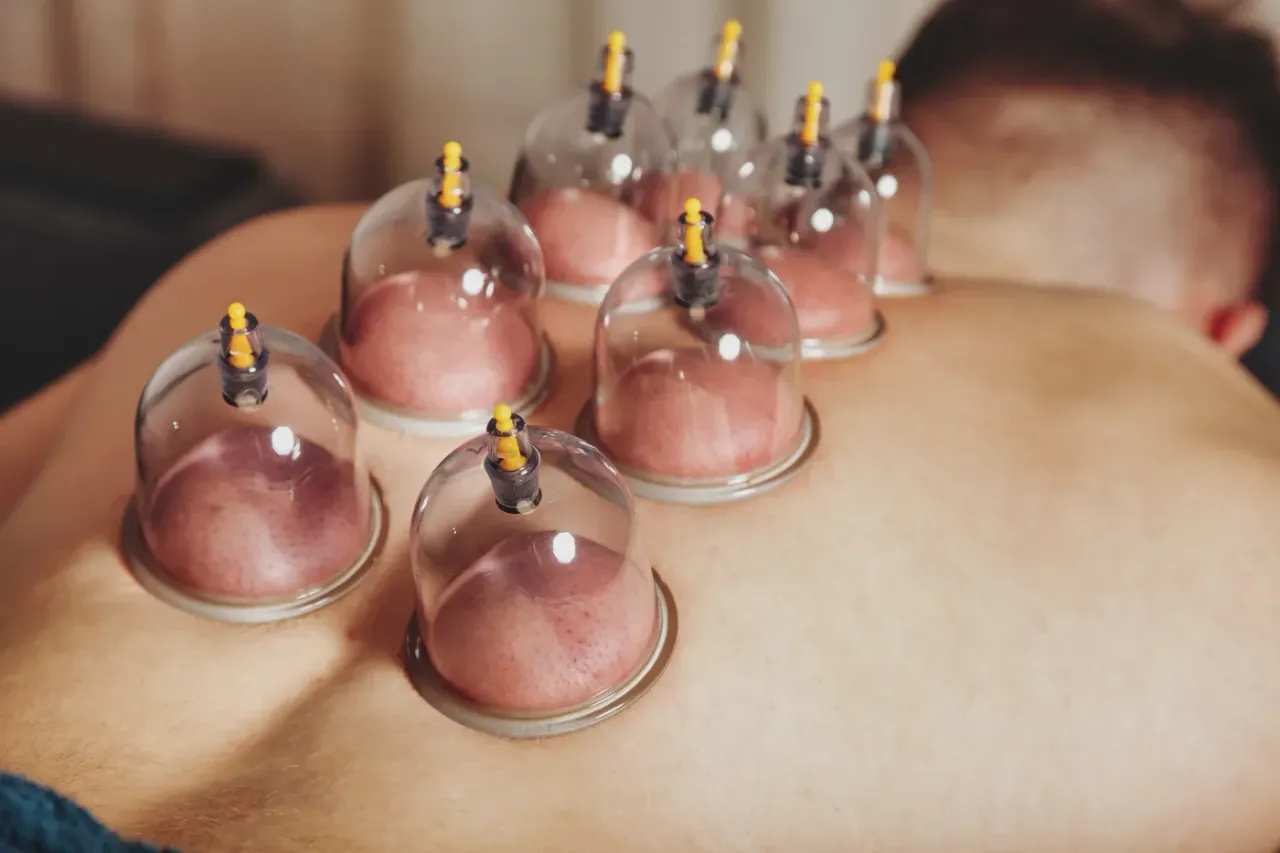
Cups create a measurable local depression. In athletes, trials remain too fragile to ground a recommendation — I use them as a tool, not as a treatment.
This article is informative and concerns a wellness practice. It does not replace medical advice, a diagnosis or treatment.
Cupping returned to Western attention after the Rio Olympic Games, when cameras lingered on the marked backs of some swimmers. Since then the technique has been everywhere, and with it a quantity of promises that are rarely checked. Competition images show a gesture. They do not say what research allows us to conclude, nor what a wellbeing session can honestly offer.
I use cups in session, occasionally, when the muscular work justifies it. Here is what you need to know before deciding whether it interests you, including what argues against it. This text distinguishes three planes: the local mechanical effect, what studies have observed, and what I actually do in my practice in Cannes.
What happens mechanically
The difference with massage is one word: direction.
Under the hands, tissues are compressed inwards. Under a cup, it is the reverse. The depression created in the bell visibly lifts the skin and the layers beneath. That is why the technique is also called myofascial decompression. The word describes a gesture, not a diagnosis and not a guaranteed clinical result.
The best-documented effect is local. A study using laser Doppler measured, after placement, peaks of cutaneous blood flow several times above the starting value; intensity varied with the pressure applied and the duration. This is a real, measurable effect, limited to the area worked. The experiment was conducted in a narrow experimental setting, on the skin, not on a competition field. It does not allow a conclusion of a general “boost” to circulation, nor a clinical effect beyond that local observation.
Two ways of working. Stationary cups stay a few minutes on a precise area. Moving cups travel along the muscle on oiled skin, in a continuous movement. The second method is the one I use most often, because it fits the rhythm of a session instead of interrupting it. In both cases, the diameter of the bell, the time of placement and the amount of suction change the sensation. A smaller diameter suits a narrow area; a wider diameter spreads the depression over a larger surface. This is not a single formula, and it is not a medical dosage.
What the research shows
In athletes, a systematic review of randomised trials published in the Journal of Alternative and Complementary Medicine noted signals on perceived pain, on joint range and on some blood markers associated with muscle fatigue, compared with groups that received no treatment.
On back pain, several meta-analyses report a reduction in pain, with results that vary widely according to the type of low back pain studied and the method used. A 2024 synthesis on low back pain, for example, gathers heterogeneous trials: protocols, comparators and populations are not superimposable. Reading “a drop in pain in some studies” is not equivalent to “cups treat the back”.
These readings describe what some studies have observed. They do not turn cups into a validated treatment, and they say nothing, on their own, about what happens in a sports massage session in Cannes. They also do not allow us to transfer to cups the effectiveness sometimes documented for massage in general: the tool is not isolated, and the setting is not the same.
What the research does not show
This is the part most websites omit, and it is the part that matters.
The authors of the review on athletes themselves conclude that no explicit recommendation can be made, for or against. Most trials presented a high or unclear risk of bias, and none reported safety data. In other words: signals exist, the method of the trials is often fragile, and one cannot use them as proof of sports recovery.
On low back pain, there is a Cochrane review protocol (CD015269) devoted to cupping in chronic non-specific low back pain.
A Cochrane protocol describes the method of a forthcoming review. It is not a completed review, and it does not allow any clinical conclusion.
Other analyses already published remain heterogeneous; some find no significant effect on chronic low back pain. A broader evidence map on cupping shows mainly an uneven field, with questions still open rather than a therapeutic consensus.
Part of the medical community considers that the available evidence does not justify presenting cupping as care. In the frame of this article, I do not present it as a medical act. Questions of reimbursement, nomenclature and official recognition belong to your scheme and to an administrative or medical opinion, not to a practice text.
What I offer belongs to wellbeing, not to medical care. I do not claim to treat any pathology. General studies on massage do not, either, allow a specific clinical effectiveness to be attributed to cups.
Marks on the skin
They surprise people, and they deserve a cautious explanation.
Suction can cause a temporary change in skin colour, tenderness, slight swelling, or marks similar to bruises. Unsuitable use can go as far as blisters, burns or infection. The appearance of the mark does not allow a diagnosis. One does not “read” an organ, a toxin or a clinical gravity in a stain.
These traces usually fade over a few days, faster in some people than in others. They are visible. If you have an event, a photo session or a competition in the days that follow, tell me before the session and we adapt: we can reduce the time, change the area, or not use the tool. Visibility is not an objective. It is not proof that the work “worked” either.
Safety and limits
When they are practised with clean equipment and a reasonable duration, dry cups are most often associated, in the synthesis literature, with minor and transient adverse effects. The more serious incidents reported almost always concern excessive durations, unsuitable equipment or an incorrect method. StatPearls reminds us that the gesture is not trivial once hygiene, time or indication leave cautious use.
I use only dry cups, in silicone, for individual use and disinfected between each person. I do not practise hijama, the version with incision, which belongs to another frame and carries other risks. Wet hijama is not “the same technique with a little more intensity”: the incision makes it a distinct invasive practice.
This article concerns only dry, non-invasive cups, used in a wellbeing practice: without incision, without diagnosis and without a therapeutic promise. This is not a legal opinion. Every practitioner must respect hygiene, insurance, the frame of her practice and the legal orientation that applies to her situation. I do not assert a general legality, valid for every status and every use in France.
Some situations require abstaining or obtaining prior medical advice. The list that follows is not exhaustive: anticoagulant treatment, clotting disorders, a skin lesion on the area concerned, pregnancy, phlebitis, cancer under treatment. If you are in one of these cases, or in another health situation that concerns you, speak to a health professional before any session. Wellbeing does not replace medical follow-up.
How I use them
Cups are not a service I sell. They are a tool among others, in the same way as bamboo, hot stones or hot oil. They have no separate price, no duration sold apart, no “cupping protocol” detached from the session.
I integrate them into a sports massage session when an area remains dense after manual work, or when someone arrives after intense effort. The time given to the tool stays short. I start with the hands, because the hand reads density, heat and tolerance. The cups, if they come in, come afterwards, on an area already worked, with suction that I adapt to what the skin and the person can bear that day.
They never replace the work of the hands. They complement it, in a session built around what the body asks. If the technique does not put you at ease, the session goes ahead without it, and nothing is lost. You can say so before, or during: we stop. The aim is not to obtain a mark, nor to reproduce a competition image. The aim is local, cautious work, within the limits of a wellbeing practice.
Sources
- Effects of Cupping Therapy in Amateur and Professional Athletes: Systematic Review of Randomized Controlled Trials — Journal of Alternative and Complementary Medicine / PubMed, 2018 · consulted on 2026-08-13 (opens in a new tab)
- Cupping therapy for chronic non-specific low back pain (protocol) — Cochrane Database of Systematic Reviews, 2025 · consulted on 2026-08-13 (opens in a new tab)
- The effectiveness of cupping therapy on low back pain: systematic review and meta-analysis of randomized control trials — PubMed, 2024 · consulted on 2026-08-13 (opens in a new tab)
- Effect of Pressures and Durations of Cupping Therapy on Skin Blood Flow Responses — PMC / NIH, 2020 · consulted on 2026-08-13 (opens in a new tab)
- Cupping Therapy — StatPearls, NCBI Bookshelf · consulted on 2026-08-13 (opens in a new tab)
- Evidence Map of Cupping Therapy — PMC / NIH, 2021 · consulted on 2026-08-13 (opens in a new tab)
Frequently asked questions
Does cupping hurt?
The suction produces an unusual sensation. This article does not describe a guaranteed painless gesture: redness, tenderness or marks may appear. If the sensation becomes uncomfortable, we stop or adapt.
Why can the skin stay marked?
Suction can cause a temporary change in skin colour, tenderness, and sometimes marks close to a bruise. These marks usually fade over a few days. Their appearance does not allow a diagnosis.
Does cupping improve sports recovery?
A review of trials in athletes noted signals on perceived pain and other markers, but its authors conclude that no explicit recommendation can be made. I do not present cups as a demonstrated recovery method.
What is the difference between dry cupping and wet hijama?
Dry cups stay on the surface, without incision. Wet hijama involves incisions: it is a different, invasive practice, which I do not offer. This article concerns dry cupping only, in a wellbeing setting.
When should I seek medical advice?
The list is not exhaustive. Medical advice is needed in particular with anticoagulant treatment, a clotting disorder, a skin lesion on the area, pregnancy, phlebitis or cancer under treatment — and in any other health situation that concerns you.
How are cups integrated into a sports massage session?
Cups are not booked separately. I may integrate them into a sports massage session, for a short time, when an area remains dense after manual work. They never replace the hands. If the technique does not suit you, the session goes ahead without it.
The author
Massage therapist in Cannes, I have practised massage for around ten years, five of them professionally. Sports massage and lymphatic drainage are the foundation of my work: deep muscular work, with stretches and tools when useful, and a drainage I adapt to the person, slow and light or more rhythmic depending on what you are looking for. My Signature massage, Ashiatsu and the massage for two or four hands complete these sessions. I receive clients in my private space in Cannes and I travel to homes, hotels and villas, from Cannes to Monaco and Saint-Tropez. Here I write what I tell my clients before a session: what each technique brings, what it does not do, and who it is not for, with the sources that trained me.
Continue to a session
The techniques described here are integrated into a session when they are relevant. They are not booked separately.