TechniquesEnglish
Bamboo massage: the origin of Bamboo-Fusion®, technique and limitations
Bamboo-Fusion® is a modern method developed by Nathalie Cecilia. Other bamboo practices exist. I use bamboo in my own practice, without presenting a certified method.
This article is informative and concerns a wellness practice. It does not replace medical advice, a diagnosis or treatment.
Unlike cupping, whose use is ancient, bamboo massage as it is practised today covers several methods. One of them, modern and precisely identified, is called Bamboo-Fusion®. It was developed by Nathalie Cecilia. Other practices with bamboo exist, with different histories. Nathalie Cecilia did not invent every form of massage with bamboo.
That distinction is worth telling, because the reason this method was developed — sparing the practitioner’s hands while offering deep pressure — is also one of the reasons I use bamboo, in my own way of working. That is not the same as teaching, certifying or selling that method.
The origin: Nathalie Cecilia and Bamboo-Fusion®
According to the history page published by Bamboo-Fusion®, Nathalie Cecilia is the founder and creator of the method. Three months after graduating from the Sarasota School of Massage, in 2004, she opened her practice, “Two Touch Company”, a Thai massage studio. She was then seeing several clients a day in deep work — the site indicates seven to eight daily sessions — and many asked for more pressure. Her hands, wrists and thumbs began to suffer from repetitive use.
One day, still according to that official account, she explored differently the bamboo poles of about six feet that she used as a support when applying compressions with the feet, in Thai massage. She used them to compress, percuss and roll muscular tissue. From that observation came the idea of bamboo tools that could be held in the hands. It took her about two years to develop the method, from raw bamboo and rattan, combining heat, deep work and gestures inspired by Swedish massage. That is what the site presents today as Bamboo-Fusion® Massage.
I keep here to what that official page states about its own history. I do not add biography, training cities or distinctions that do not appear there.
Bamboo-Fusion® is not “bamboo massage” as a whole. Other brands and trainings exist, including Bamboossage®, distinct from Bamboo-Fusion®. They are not the subject of this article, and I do not present them as a recommendation. I also do not document a list of courses, dates, states or continuing-education units: that information changes, and it does not belong to my practice.
Bamboo-Fusion® is a specific brand and method. I am not certified in Bamboo-Fusion® and I do not claim to offer the certified method. What I describe here is the professional use of bamboo in my own practice, within the wellbeing frame already presented on this site. This article documents no French state certification, nor any training I would have followed.
Why a tool changes the pressure
Bamboo does not replace the hand. It does something else.
The hand is a reading tool: it feels the density of the tissue, the temperature, the resistance, the moment when an area yields. No wooden stick does that. That is why I always start with the hands, and why the tool is never obligatory.
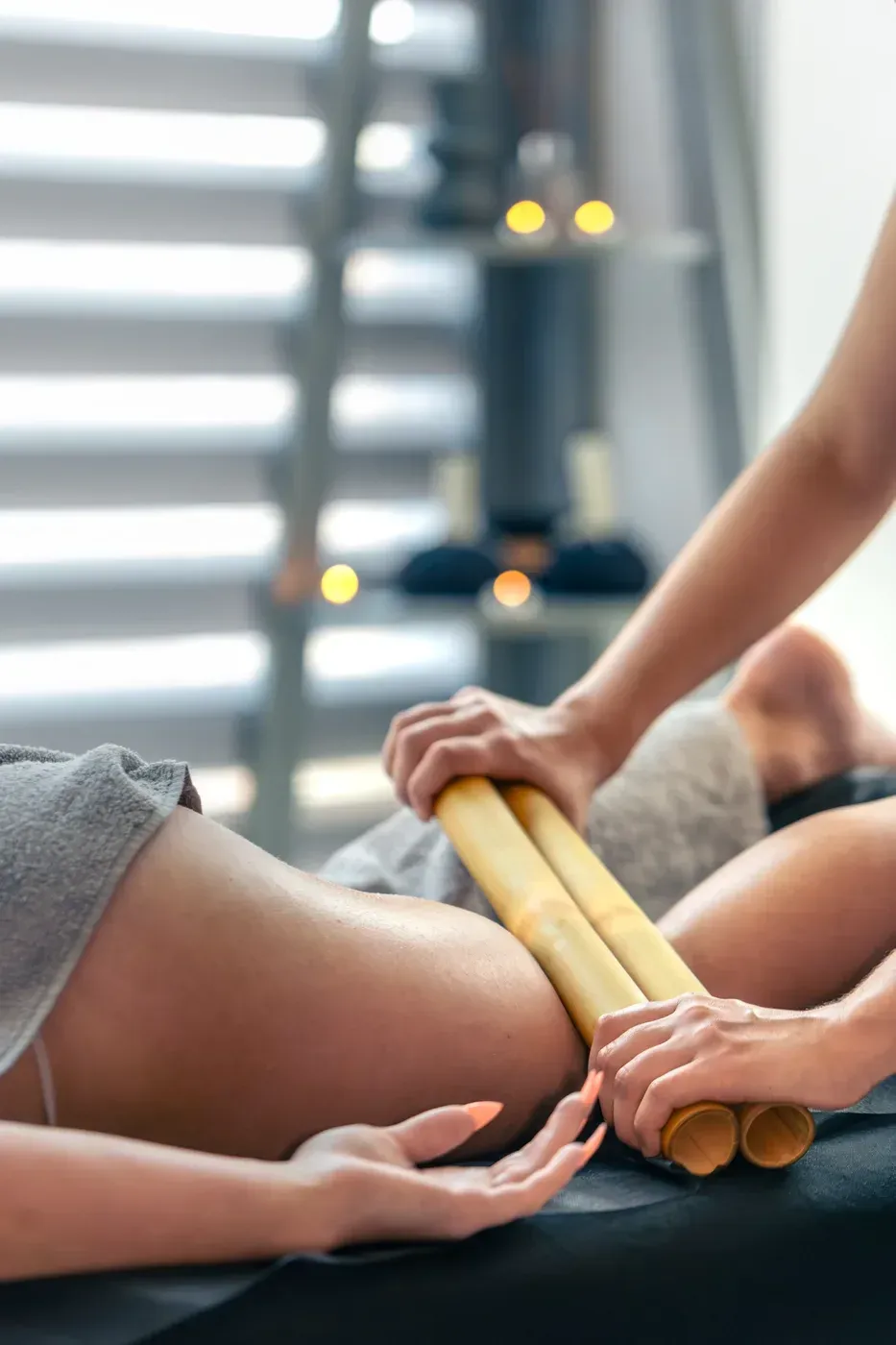
The hand, however, has physical limits. To maintain deep, even pressure over a large surface, the thumb and wrist pay. The bamboo stick distributes force differently: it allows continuous pressure along a muscle group, without the practitioner’s joint absorbing the whole load. On a thigh, a calf or along the back, the contact surface is not that of a thumb. The stimulus changes. The person receiving it often describes it as “wider” or “more linear” — that is a reported sensation, not a clinical measurement.
This is a mechanical description, and a technical intention. It is not proof that oil massage would in itself tire the body that receives it, nor that bamboo “would do better” than the hands in every case. I do not oppose oil to bamboo. Oil remains a gliding support. Alternating tools during a session changes the stimulus and helps me hold the quality of the gesture, including for my own joints.
Finally, bamboo can be warm. Heat, applied before deeper work, prepares the tissue and can make the pressure more bearable. Again, this is an observation from practice, not a clinical trial result. A stick that is too hot has no place; a cold stick adds nothing useful to this intention. Preparation is done before the person settles, not in the middle of an improvised gesture.
What the research says — and especially what it does not
Here I must be frank: there are practically no clinical studies specifically on bamboo massage.
That is not a detail. It means that any claim of the type “bamboo eliminates toxins” or “bamboo destroys cellulite” is founded on nothing verifiable. You will find plenty of them online, often on commercial pages. That is not evidence.
What we have is research on massage in general — and it does not isolate the tool. An evidence map produced for the U.S. Department of Veterans Affairs, published in JAMA Network Open in 2024, examined systematic reviews published since 2018. A few conclusions reached a moderate level of certainty, notably for some pains (chronic low back pain, fibromyalgia, myofascial pain). Several of those conclusions concern specific approaches, such as myofascial work or acupressure, and not “massage” as a single category. Most other conclusions remained of low or very low certainty. The tool used — hand or bamboo — was not isolated as a variable.
In other words: massage has documented effects on some pains, with a more modest strength of evidence than the sector often suggests. Transferring those results to bamboo massage as if they demonstrated a specific effectiveness would be incorrect. The absence of a specific trial is not proof of ineffectiveness either: it is simply a gap. I prefer to name it.
What I can describe without presenting it as a clinical result is my experience: bamboo allows deep, even pressure, it spares my joints, and in my practice many people describe a sensation different from that of the hands alone. That is honest. It is not proof. It is not a before/after either, nor a named client testimonial.
What this is not
This is not medical care. I treat no pathology and I make no diagnosis.
It is not a service I sell separately either. Bamboo is a tool, in the same way as cups, hot stones or hot oil. It comes inside a sports massage session, for a short time, when the work justifies it. No “bamboo” package, no promise of a result, no official method sold under another name.
In a session, bamboo arrives after a first period of manual reading. I do not start with the tool. If an area of the back, thigh or calf asks for a more extended pressure, I can glide the bamboo along the muscle, then return to the hands to check what the tissue gives. The time stays limited. This is not a fixed sequence, and it is not a protocol I sell under a method name.
And it is not obligatory. If the tool does not appeal to you, the session goes ahead without it. The hand is enough to build the work. The tool is only an option, within the frame already described on this site.
Precautions
Bamboo allows substantial pressure, which requires adapting it. An inflamed area, a recent lesion, fragile skin or anticoagulant treatment require reducing intensity, working around the area, or leaving the tool aside. This list is not exhaustive. If you have any doubt about your health, ask a health professional first.
I prepare the bamboo sticks before the session, with oil, and I may use them warm when the work justifies it. They are cleaned between people. This is not a medical sterilisation protocol, and I do not present it as such. It is cabinet hygiene, in a wellbeing practice.
I always prefer to ask the question before starting rather than correct during the session. If the pressure becomes uncomfortable, we lighten it or return to the hands. Nothing in this article replaces medical advice, a diagnosis or a treatment.
Sources
- History of Bamboo Fusion Massage — Bamboo-Fusion® / Nathalie Cecilia · consulted on 2026-08-13 (opens in a new tab)
- Use of Massage Therapy for Pain, 2018-2023: A Systematic Review — JAMA Network Open, 2024 · consulted on 2026-08-13 (opens in a new tab)
- Evidence Map of Massage Therapy for Painful Conditions: Update from 2018-2023 — U.S. Department of Veterans Affairs, Evidence Synthesis Program, 2023 · consulted on 2026-08-13 (opens in a new tab)
Frequently asked questions
Is bamboo massage painful?
Bamboo allows substantial pressure, which I adapt. A tender area, a recent lesion or fragile skin require reducing intensity, working around the area, or leaving the tool aside. Nothing is obligatory.
What is bamboo fusion massage?
Bamboo-Fusion® is a specific modern brand and method, developed by Nathalie Cecilia. It is not “bamboo massage” as a whole: other practices exist, with different histories. I am not certified in Bamboo-Fusion® and I do not offer the certified method.
What does bamboo massage mean?
In a broad sense, it means using bamboo sticks to glide, compress or roll muscular tissue. It is not a service I sell separately: bamboo is a tool, inside a sports massage session, when the work justifies it.
Is bamboo massage good for legs?
I can glide the bamboo along a thigh, a calf or the back, after a first period of manual reading. It is not a “legs” treatment to book, nor a promise of a result. If the pressure does not suit you, we return to the hands.
Is Michelle Dias certified in Bamboo-Fusion®?
No. I am not certified in Bamboo-Fusion® and I do not offer the certified method. I describe the professional use of bamboo in my own wellbeing practice in Cannes.
When should I seek medical advice?
The list is not exhaustive. An inflamed area, a recent lesion, fragile skin or anticoagulant treatment require adapting or leaving the tool aside. If you have any doubt about your health, ask a health professional first.
Are there specific studies on bamboo massage?
There is very little clinical research specifically on bamboo massage. General work on massage does not allow a distinct effectiveness to be attributed to bamboo. Any promise of the type “eliminate toxins” or “destroy cellulite” has no verifiable basis here.
The author

Massage therapist in Cannes, I have practised massage for around ten years, five of them professionally. Sports massage and lymphatic drainage are the foundation of my work: deep muscular work, with stretches and tools when useful, and a drainage I adapt to the person, slow and light or more rhythmic depending on what you are looking for. My Signature massage, Ashiatsu and the massage for two or four hands complete these sessions. I receive clients in my private space in Cannes and I travel to homes, hotels and villas, from Cannes to Monaco and Saint-Tropez. Here I write what I tell my clients before a session: what each technique brings, what it does not do, and who it is not for, with the sources that trained me.
Continue to a session
The techniques described here are integrated into a session when they are relevant. They are not booked separately.